Materials behave differently when an electric current is applied to them. So, the difference between Electrical Conductors vs Insulators can be found according to the behaviour of materials.
This difference is important in everyday electrical systems. Metals such as copper are used to carry electric current, while materials such as plastic and rubber are commonly used to protect us from electric shocks.
What Is an Electrical Conductor?
An electrical conductor is a material that allows electric charge to move through it relatively easily.
In metals, some electrons are not tightly bound to individual atoms. These mobile electrons can move through the material when an electric potential difference is applied.
Examples of Conductors
Common electrical conductors include:
- Copper
- Aluminium
- Silver
- Gold
- Iron
- Graphite
Copper is widely used in electrical wiring because it has good electrical conductivity and is practical for many applications.
Uses of Electrical Conductors
Conductors are used wherever electric current needs to be carried from one place to another.
Examples include:
- Electrical wires
- Power cables
- Circuit connections
- Electrical contacts
- Motor windings
- Household wiring
For example, copper wires are commonly used inside electrical cables to carry current.
What Is an Electrical Insulator?
An electrical insulator is a material that strongly resists the movement of electric charge through it.
In insulating materials, electrons are generally tightly bound to their atoms, so there are very few mobile charge carriers available to carry an electric current under normal conditions.
Examples of Insulators
Common electrical insulators include:
- Rubber
- Plastic
- Glass
- Dry wood
- Ceramic
- Mica
- Air
Uses of Electrical Insulators
Insulators are used to prevent unwanted current flow and provide electrical protection.
Examples include:
- Plastic covering around electrical wires
- Rubber electrical gloves
- Insulating parts of electrical appliances
- Ceramic insulators on power lines
- Plastic handles on electrical tools
For example, the copper inside an electrical cable carries current, while the plastic covering helps protect people from contact with the conductors.
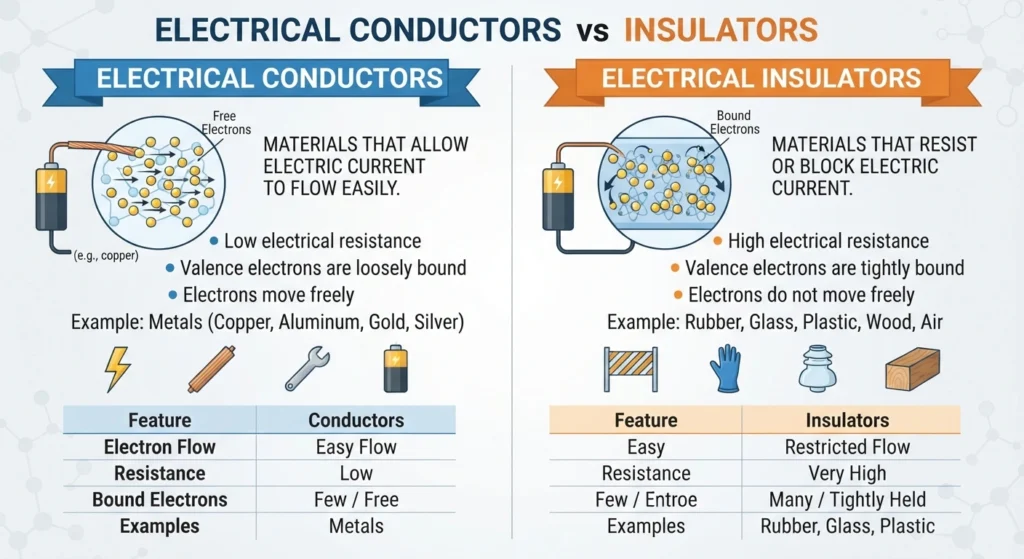
Electrical Conductors vs Insulators – Quick Difference
| Electrical Conductors | Electrical Insulators |
|---|---|
| Allow electric charge to flow easily. | Strongly resist the flow of electric charge. |
| Have many mobile charge carriers, such as free electrons in metals. | Have very few mobile charge carriers under normal conditions. |
| Have low electrical resistance. | Have high electrical resistance. |
| Usually contain electrons that can move relatively freely through the material. | Electrons are more tightly bound to atoms. |
| Metals are common conductors. | Rubber, plastic and glass are common insulators. |
| Used to carry electric current. | Used to prevent unwanted current flow and provide electrical protection. |
Easy Example to Understand the Difference
Consider an ordinary electrical wire.
Inside the wire is usually a metal conductor, such as copper.
The copper allows electric current to flow through the wire.
Around the copper is an insulating material, such as plastic.
The plastic does not allow current to flow easily and helps protect people from accidentally touching the conducting wire.
So remember:
Copper → Carries current
Plastic → Provides insulation
Are All Metals Good Conductors?
Most metals are good electrical conductors, but their conductivity is not exactly the same.
For example, silver has very high electrical conductivity, while copper is widely used for electrical wiring because it combines good conductivity with practical cost and availability.
Are All Non-Metals Insulators?
No. This is an important point.
Most common non-metallic insulating materials do not conduct electricity well, but some non-metals can conduct electricity.
For example, graphite, a form of carbon, conducts electricity.
Therefore, it is better to classify materials according to their electrical properties rather than simply saying:
Metal = conductor
Non-metal = insulator
What Happens When a Conductor Is Connected to a Battery?
When a conducting material is connected to a source such as a battery, an electric field is established in the circuit. Mobile charge carriers respond to this field, producing an electric current.
In a metal wire, the moving charge carriers are mainly electrons.
What Happens in an Insulator?
In an insulator, charge carriers are not able to move freely through the material under normal conditions.
As a result, an ordinary applied voltage produces very little current compared with a conductor.
However, an insulator is not necessarily completely unable to conduct electricity. Under sufficiently high electric fields or special conditions, even insulating materials can conduct.
Frequently Asked Questions
What is an electrical conductor?
An electrical conductor is a material that allows electric charge to move through it relatively easily.
What is an electrical insulator?
An electrical insulator is a material that strongly resists the movement of electric charge.
Give two examples of conductors.
Copper and aluminium are common examples of electrical conductors.
Give two examples of insulators.
Rubber and plastic are common examples of electrical insulators.
Why is copper used in electrical wires?
Copper has good electrical conductivity, so it allows electric current to flow efficiently through wires.
Why are electrical wires covered with plastic?
Plastic is a good electrical insulator. It helps prevent unwanted current flow and reduces the risk of electric shock.
Which has greater resistance: a conductor or an insulator?
An insulator generally has much higher electrical resistance than a conductor.
Is graphite a conductor or an insulator?
Graphite is an electrical conductor, even though carbon is a non-metal.
One-Line Difference for Exams
Conductors allow electric charge to flow easily, whereas insulators strongly resist the flow of electric charge.
Quick Revision
Electrical Conductors
Allow charge to move easily
↓
Many mobile charge carriers
↓
Low resistance
↓
Examples: Copper, aluminium, silver
↓
Used in electrical wiring and circuits
Electrical Insulators
Resist the movement of charge
↓
Very few mobile charge carriers
↓
High resistance
↓
Examples: Rubber, plastic, glass
↓
Used for electrical insulation and protection