Mechanical waves and electromagnetic waves are two important types of waves studied in physics. The main difference is that mechanical waves require a material medium to travel, while electromagnetic waves can travel through a vacuum.
What Are Mechanical Waves?
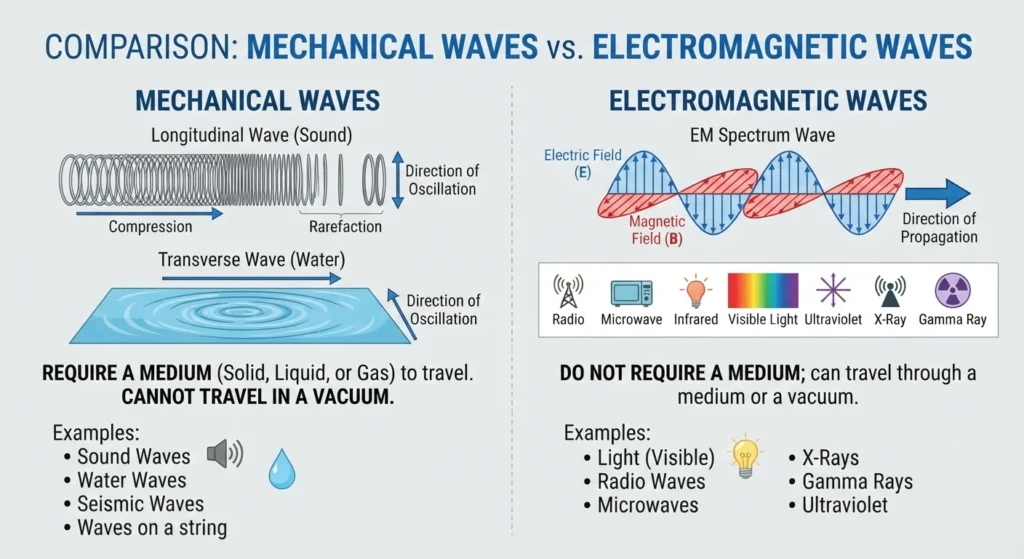
A mechanical wave is a wave that requires a material medium for its propagation.
The medium may be a:
- Solid
- Liquid
- Gas
Mechanical waves transfer energy through the vibration or oscillation of particles in the medium.
For example, when a sound wave travels through air, the air particles vibrate and pass the disturbance from one particle to another.
Examples of Mechanical Waves
- Sound waves
- Waves on a stretched string
- Water waves
- Seismic waves
- Waves travelling through a spring
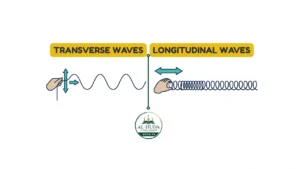
Mechanical waves can be transverse or longitudinal, depending on the direction of particle vibration relative to the direction of wave propagation.
What Are Electromagnetic Waves?
An electromagnetic wave is a wave consisting of changing electric and magnetic fields that can propagate through space.
Unlike mechanical waves, electromagnetic waves do not need a material medium.
This means they can travel through a vacuum.
For example, light from the Sun travels through the nearly empty space between the Sun and Earth before reaching us.
Examples of Electromagnetic Waves
The electromagnetic spectrum includes:
- Radio waves
- Microwaves
- Infrared waves
- Visible light
- Ultraviolet rays
- X-rays
- Gamma rays
All electromagnetic waves travel at the speed of light in vacuum:
c ≈ 3 × 10⁸ m/s
Mechanical Waves vs Electromagnetic Waves – Quick Difference
| Mechanical Waves | Electromagnetic Waves |
|---|---|
| Require a material medium to travel. | Do not require a material medium. |
| Cannot travel through a vacuum. | Can travel through a vacuum. |
| Produced by vibrations of particles in a medium. | Produced by changing electric and magnetic fields. |
| Can be transverse or longitudinal. | Are transverse waves. |
| Examples include sound and waves on a string. | Examples include light, radio waves and X-rays. |
| Their speed depends on the medium. | Their speed in vacuum is about 3 × 10⁸ m/s. |
| Need matter such as a solid, liquid or gas for propagation. | Can travel through empty space. |
Simple Example to Understand the Difference
Imagine a sound wave produced by a speaker.
The speaker makes the surrounding air vibrate. These vibrations move through the air and eventually reach your ears.
This is a mechanical wave because a material medium—air—is required.
Now think about sunlight.
Light travels from the Sun to Earth through space. Most of the space between them is a vacuum, but the light still reaches Earth.
This is an electromagnetic wave.
Easy way to remember
Mechanical = needs matter
Electromagnetic = can travel through empty space
Mechanical vs Electromagnetic Waves – Comparison Table
| Property | Mechanical Waves | Electromagnetic Waves |
|---|---|---|
| Medium required | Yes | No |
| Travel through vacuum | No | Yes |
| Produced by | Vibrations/disturbances in a medium | Changing electric and magnetic fields |
| Nature | Can be transverse or longitudinal | Transverse |
| Speed in vacuum | Cannot travel in vacuum | 3 × 10⁸ m/s |
| Examples | Sound, seismic waves, string waves | Light, radio, X-rays, gamma rays |
| Particle vibration | Involves particles of the medium | No material particles are required |
| Energy transfer | Through the medium | Through electromagnetic fields |
Important Point About Sound and Light
A very common exam question is:
Why can light travel through space but sound cannot?
Answer:
Light is an electromagnetic wave, so it does not require a material medium for propagation. Sound is a mechanical wave and requires a material medium such as air, water or a solid.
Therefore:
Light → Can travel through vacuum
Sound → Cannot travel through vacuum
This is why astronauts in space cannot hear ordinary sound travelling directly through the vacuum of space, although they can communicate using radio communication systems.
Frequently Asked Questions
What is a mechanical wave?
A mechanical wave is a wave that requires a material medium for its propagation.
What is an electromagnetic wave?
An electromagnetic wave is a wave associated with changing electric and magnetic fields that can propagate without a material medium.
Can mechanical waves travel through vacuum?
No. Mechanical waves require a material medium and therefore cannot travel through a vacuum.
Can electromagnetic waves travel through vacuum?
Yes. Electromagnetic waves can travel through a vacuum.
Is sound a mechanical wave?
Yes. Sound is a mechanical wave. In air, it is a longitudinal wave.
Is light a mechanical wave?
No. Light is an electromagnetic wave.
Which waves can travel through empty space?
Electromagnetic waves can travel through empty space or vacuum.
Which type of wave requires a medium?
Mechanical waves require a material medium.
One-Line Difference for Exams
Mechanical waves require a material medium for propagation, whereas electromagnetic waves do not require a material medium and can travel through vacuum.
Quick Revision
Mechanical Waves
Need medium → Cannot travel in vacuum → Can be transverse or longitudinal → Example: Sound
Electromagnetic Waves
No medium required → Can travel in vacuum → Transverse → Example: Light
Remember:
Mechanical = Medium required
Electromagnetic = Empty space is possible
Key Takeaway
The easiest way to distinguish mechanical and electromagnetic waves is to ask:
“Does the wave need a material medium to travel?”
Yes → Mechanical wave
No → Electromagnetic wave
Sound needs a medium, while light does not. This simple difference helps you remember most of the important distinctions between the two types of waves.