Not all sound can be heard by the human ear. Infrasound has a very low frequency, while ultrasound has a very high frequency. Both are outside the normal range of human hearing, but they have different properties and uses. Understanding their frequency ranges and examples makes it easy to tell them apart.
What Is Infrasound?
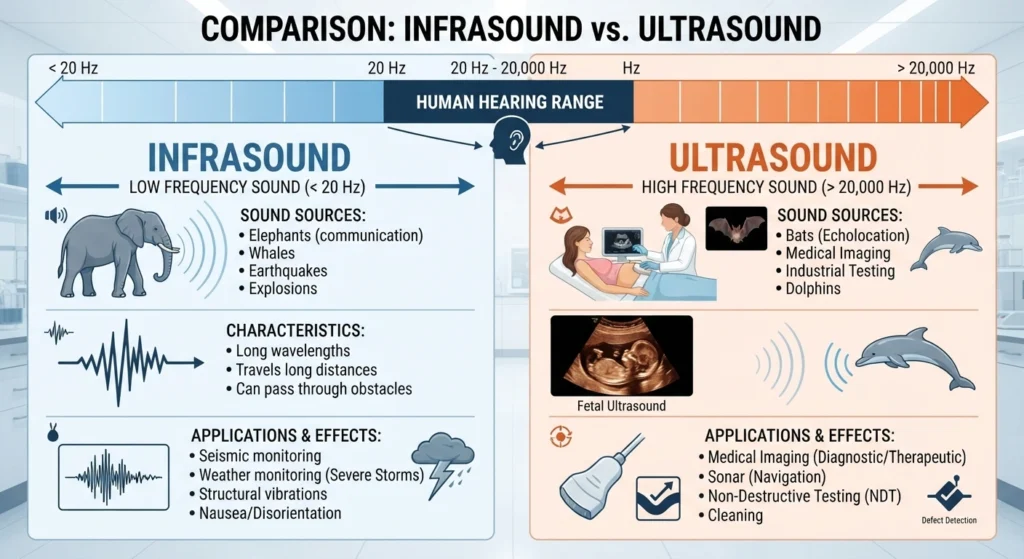
Infrasound refers to sound waves having frequencies below 20 Hz.
These frequencies are too low for normal human hearing.
Infrasound can be produced by large-scale natural events and some human activities.
Examples of Infrasound
Infrasound may be associated with:
- Earthquakes
- Volcanic eruptions
- Thunderstorms
- Large explosions
- Ocean waves
- Large machinery
Some animals can detect very low-frequency sounds. For example, elephants are known to communicate using low-frequency sounds that can travel considerable distances.
Uses of Infrasound
Infrasound can be useful for:
- Monitoring volcanic activity
- Detecting and studying large explosions
- Studying atmospheric disturbances
- Monitoring some large natural events
- Scientific research into low-frequency sound
What Is Ultrasound?
Ultrasound refers to sound waves having frequencies above 20,000 Hz (20 kHz).
These frequencies are higher than the normal upper limit of human hearing.
Humans generally cannot hear ultrasound, but some animals can produce or detect ultrasonic sounds.
Examples of Ultrasound
Ultrasound is associated with:
- Bats
- Dolphins
- Medical ultrasound equipment
- Ultrasonic cleaning devices
- Industrial testing equipment
Uses of Ultrasound
Ultrasound has many practical applications.
1. Medical Imaging
Ultrasound is widely used to produce images of structures inside the body.
2. SONAR
Ultrasonic waves can be used in underwater applications to detect objects and determine distances.
3. Cleaning
Ultrasonic cleaners are used to clean objects such as instruments and small components.
4. Detecting Defects
Ultrasound can be used to detect cracks and internal defects in some materials without cutting them open.
Infrasound vs Ultrasound – Quick Difference
| Infrasound | Ultrasound |
|---|---|
| Frequency is below 20 Hz. | Frequency is above 20 kHz (20,000 Hz). |
| Cannot normally be heard by humans. | Cannot normally be heard by humans. |
| Has a frequency lower than audible sound. | Has a frequency higher than audible sound. |
| Produced by earthquakes, volcanoes and some large natural events. | Produced by special devices and some animals. |
| Used in monitoring earthquakes and atmospheric phenomena. | Used in medical imaging, cleaning and industrial applications. |
| Some animals can detect infrasound. | Some animals such as bats and dolphins can produce or detect ultrasound. |
| Wavelength is relatively large for a given speed. | Wavelength is relatively small for a given speed. |
Human Audible Range
Understanding the human hearing range makes this topic very easy.
INFRASOUND          AUDIBLE SOUND             ULTRASOUND
     |-------------------|-------------------------|
    <20 Hz            20 Hz – 20 kHz            >20 kHz
Remember:
Infrasound → below hearing
Ultrasound → above hearing
Infrasound and Ultrasound in Animals
Some animals can detect frequencies that humans cannot normally hear.
Infrasound
Some large animals, including elephants, can use low-frequency sounds for communication.
Ultrasound
Bats use ultrasonic sounds for echolocation, helping them detect objects and navigate their surroundings.
Dolphins also use high-frequency sounds for echolocation.
Frequently Asked Questions
What is infrasound?
Infrasound is sound having a frequency below 20 Hz.
What is ultrasound?
Ultrasound is sound having a frequency above 20 kHz (20,000 Hz).
Can humans hear infrasound?
Normally, humans cannot hear frequencies below about 20 Hz.
Can humans hear ultrasound?
Normally, humans cannot hear frequencies above about 20 kHz.
What is the frequency range of human hearing?
The commonly used approximate range is 20 Hz to 20 kHz.
Which has a higher frequency: infrasound or ultrasound?
Ultrasound has the higher frequency.
Which has the longer wavelength?
At the same wave speed, infrasound has the longer wavelength because it has the lower frequency.
Are infrasound and ultrasound electromagnetic waves?
No. Both are forms of sound, so they are mechanical waves and require a medium to propagate.
What is ultrasound used for?
Ultrasound is used in medical imaging, industrial testing, cleaning, underwater detection and several other applications.
One-Line Difference for Exams
Infrasound has a frequency below 20 Hz, whereas ultrasound has a frequency above 20,000 Hz.