Myopia and hypermetropia are two common defects of vision. In myopia, a person can usually see nearby objects clearly but has difficulty seeing distant objects. In hypermetropia, nearby objects are difficult to see clearly, while distant objects may be seen more clearly.
What Is Short-Sightedness (Myopia)?
Myopia, commonly called short-sightedness, is a defect of vision in which nearby objects can be seen clearly but distant objects appear blurred.
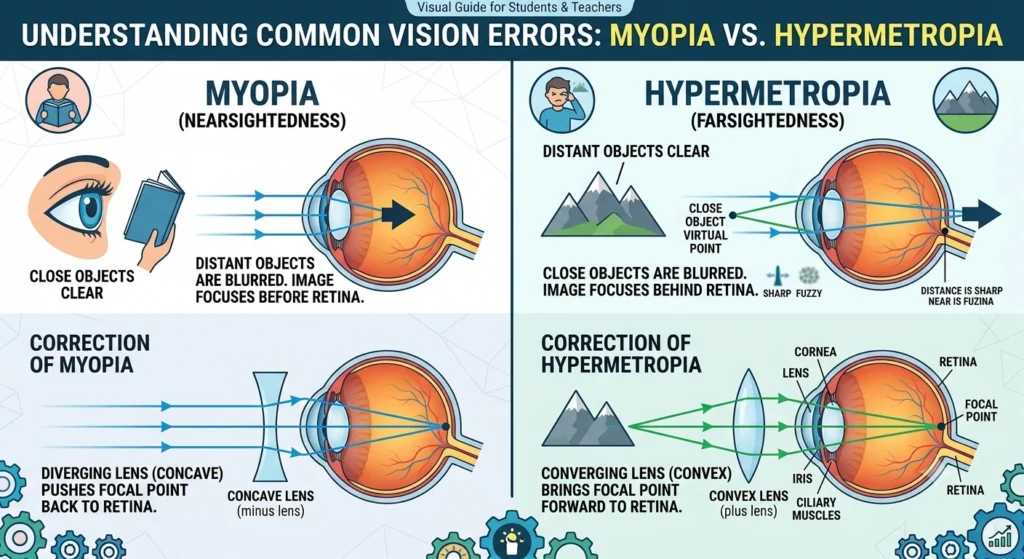
In a myopic eye, light from a distant object is focused in front of the retina instead of directly on the retina.
What happens in myopia?
Normally, the eye should focus light directly on the retina.
In myopia, the eye focuses the light too strongly or the eyeball is relatively too long. As a result, the image of a distant object forms in front of the retina.
Therefore, distant objects appear blurred.
Common causes of myopia
Myopia may occur when:
- The eyeball is longer than normal.
- The focusing power of the eye is too strong.
- The cornea or lens causes excessive convergence of light.
How is myopia corrected?
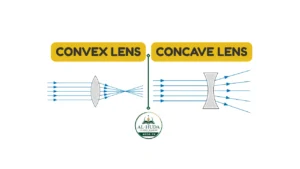
Myopia is corrected using a concave lens.
A concave lens is a diverging lens. It spreads the incoming light rays slightly before they enter the eye, allowing the eye to focus the image on the retina.
Myopia → Concave lens
What Is Long-Sightedness (Hypermetropia)?
Hypermetropia, commonly called long-sightedness or farsightedness, is a defect of vision in which nearby objects appear blurred while distant objects may be seen more clearly.
In a hypermetropic eye, light from a nearby object would be focused behind the retina if the eye’s focusing system does not provide enough convergence.
What happens in hypermetropia?
The eye does not converge the light rays enough to form the image on the retina for a nearby object.
The rays would meet behind the retina instead.
As a result, nearby objects appear blurred.
Common causes of hypermetropia
Hypermetropia may occur when:
- The eyeball is shorter than normal.
- The focusing power of the eye is insufficient.
- The cornea or lens does not provide enough convergence.
How is hypermetropia corrected?
Hypermetropia is corrected using a convex lens.
A convex lens is a converging lens. It brings the incoming light rays closer together before they enter the eye, helping the eye focus the image on the retina.
Hypermetropia → Convex lens
Myopia vs Hypermetropia – Quick Difference
| Short-Sightedness (Myopia) | Long-Sightedness (Hypermetropia) |
|---|---|
| Nearby objects can usually be seen clearly. | Distant objects can usually be seen more clearly. |
| Distant objects appear blurred. | Nearby objects appear blurred. |
| Image of a distant object forms in front of the retina. | Image of a near object tends to form behind the retina. |
| Corrected using a concave (diverging) lens. | Corrected using a convex (converging) lens. |
| Often caused by an eyeball that is too long or excessive focusing power of the eye. | Often caused by an eyeball that is too short or insufficient focusing power of the eye. |
| Concave lens spreads the incoming rays before they enter the eye. | Convex lens converges the incoming rays before they enter the eye. |
Easy Example to Understand the Difference
Imagine a student sitting in a classroom.
If the student can easily read a book on the desk but cannot clearly see writing on the classroom board from a distance, this may indicate myopia.
If the student can see the classroom board reasonably well but has difficulty reading a book held close to the eyes, this may indicate hypermetropia.
Simple rule:
Can’t see far clearly → Myopia
Can’t see near clearly → Hypermetropia
Why Are Different Lenses Used?
The two defects require opposite corrections because the light needs to be adjusted in opposite ways.
For Myopia
The eye focuses incoming light too early, forming the image in front of the retina.
A concave lens diverges the incoming rays slightly so that the eye can bring them to focus on the retina.
For Hypermetropia
The eye does not converge incoming light enough for a nearby object.
A convex lens converges the incoming rays before they enter the eye, helping the eye form the image on the retina.
Symptoms of Myopia
Common signs may include:
- Difficulty seeing distant objects clearly
- Squinting to see distant objects
- Difficulty reading distant writing
- Sitting close to the television or classroom board
Symptoms of Hypermetropia
Common signs may include:
- Difficulty seeing nearby objects clearly
- Eye strain during close work
- Difficulty reading for long periods
- Headaches after close-up activities
Symptoms can have other causes, so an eye examination is the appropriate way to determine the actual vision problem.
Frequently Asked Questions
What is myopia?
Myopia is a defect of vision in which distant objects appear blurred while nearby objects can usually be seen clearly.
Which lens is used to correct myopia?
A concave lens is used to correct myopia.
What is hypermetropia?
Hypermetropia is a defect of vision in which nearby objects appear blurred while distant objects may be seen more clearly.
Which lens is used to correct hypermetropia?
A convex lens is used to correct hypermetropia.
Where is the image formed in myopia?
For a distant object, the image is formed in front of the retina.
Where is the image formed in hypermetropia?
For a near object, the image would be formed behind the retina.
What is the main difference between myopia and hypermetropia?
Myopia mainly causes difficulty seeing distant objects, whereas hypermetropia mainly causes difficulty seeing nearby objects.
Quick Revision
Myopia
Short-sightedness
↓
Distant objects appear blurred
↓
Image forms in front of retina
↓
Corrected with concave lens
Hypermetropia
Long-sightedness
↓
Nearby objects appear blurred
↓
Image would form behind retina
↓
Corrected with convex lens