Do you know the difference between Concave and Convex lenses? If not, then please concentrate on each point clearly.
What are lenses?
Lenses are transparent optical devices that bend (refract) light to form images.
What is a Convex Lens?
A convex lens is thicker in the middle and thinner at the edges. It is also called a converging lens because it bends parallel light rays inward, bringing them together at a single point called the focal point.
Key features:
- Bulges outward on both sides (or at least one side)
- Converges (focuses) light rays
- Has a positive focal length
- Can form both real and virtual images, depending on object distance
What is a Concave Lens?
A concave lens is thinner in the middle and thicker at the edges. It is also called a diverging lens because it spreads out parallel light rays instead of focusing them.
Key features:
- Curves inward on both sides (or at least one side)
- Diverges (spreads out) light rays
- Has a negative focal length
- Always forms a virtual, erect, and diminished (smaller) image
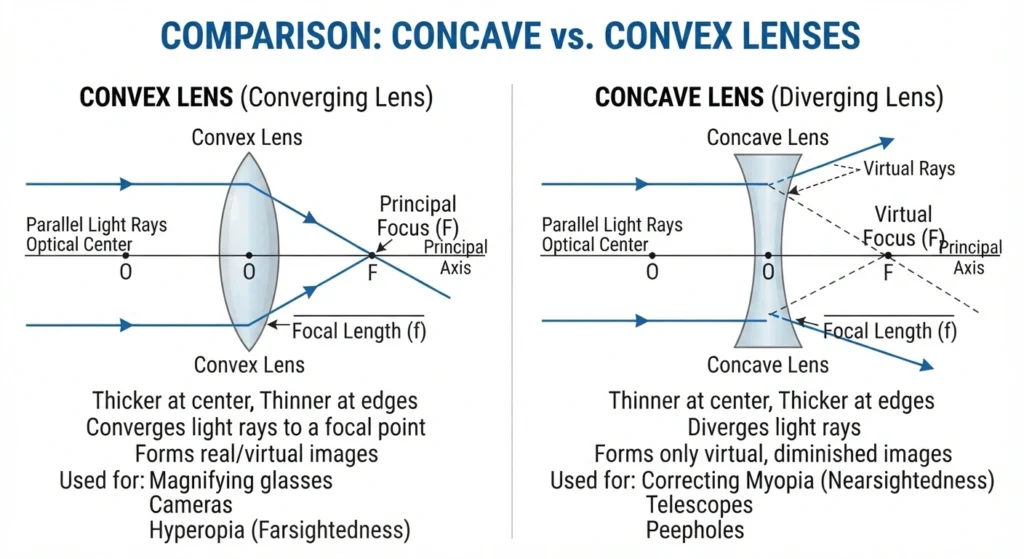
Concave vs Convex Lens: Key Differences (Comparison Table)
| Feature | Convex Lens | Concave Lens |
|---|---|---|
| Shape | Thick at the center, thin at the edges | Thin at center, thick at edges |
| Also known as | Converging lens | Diverging lens |
| Effect on light | Converges (focuses) light rays | Diverges (spreads) light rays |
| Focal length | Positive (+) | Negative (−) |
| Image type | Real or virtual (depends on object position) | Always virtual |
| Image size | Can be smaller, the same, or larger | Always smaller (diminished) |
| Image orientation | Can be inverted or erect | Always erect (upright) |
| Common uses | Magnifying glass, camera lens, telescope, correcting hypermetropia (long-sightedness) | Correcting myopia (short-sightedness), peepholes, some flashlights |
Real-Life Applications
Convex Lens Uses:
- Magnifying glasses
- Cameras and projectors
- Microscopes and telescopes
- Eyeglasses for hypermetropia (far-sightedness)
- Human eye’s natural lens
Concave Lens Uses:
- Eyeglasses for myopia (near-sightedness)
- Peepholes in doors (wide-angle viewing)
- Flashlights and laser devices (to spread light)
- Binoculars (in combination with convex lenses)
Frequently Asked Questions (FAQs)
Q1. Which lens is used in the human eye?
The human eye’s natural lens is a convex lens, which focuses light onto the retina.
Q2. Can a concave lens form a real image?
No, a concave lens always forms a virtual image, regardless of the object’s position.
Q3. Why is a convex lens called a converging lens?
Because it bends incoming parallel light rays toward a single focal point on the other side of the lens.
Q4. What type of spectacles use concave lenses?
Spectacles for myopia (short-sightedness) use concave lenses to diverge light before it enters the eye.