Transverse waves and longitudinal waves are two important types of waves. The main difference between them is the direction in which the particles of the medium vibrate compared with the direction in which the wave travels.
Transverse Wave
In a transverse wave, particles vibrate perpendicular to the direction of wave propagation.
For example, if you move a rope up and down, the disturbance travels along the rope while the rope moves up and down.
This means:
Particle vibration ⟂ Direction of wave travel
Common examples include:
- Waves on a stretched string
- Electromagnetic waves such as light
- Some seismic waves
- Surface water waves, when treated in the simple introductory model
Transverse waves are commonly represented by crests and troughs.
Easy way to remember
Transverse = vibration across the direction of travel.
Imagine moving your hand up and down while a wave travels forward along a rope.
Longitudinal Wave
In a longitudinal wave, particles vibrate parallel to the direction of wave propagation.
A simple example is a sound wave travelling through air. Air particles vibrate back and forth in the same general direction in which the sound wave travels.
This means:
Particle vibration ∥ Direction of wave travel
Longitudinal waves consist of alternating regions called:
- Compressions – regions where particles are closer together
- Rarefactions – regions where particles are farther apart
Sound is a familiar example of a longitudinal mechanical wave.
Easy way to remember
Longitudinal = vibration along the direction of travel.
Think of pushing and pulling a slinky back and forth. The disturbance and the motion of the coils are along the same direction.
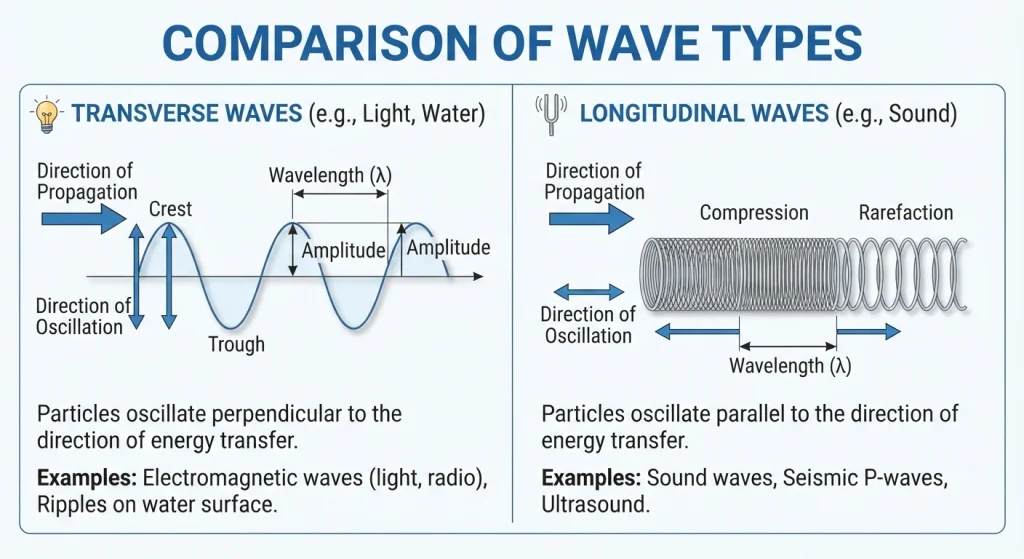
Transverse Waves vs Longitudinal Waves – Quick Difference
| Transverse Waves | Longitudinal Waves |
|---|---|
| Particles vibrate perpendicular to the direction of wave travel. | Particles vibrate parallel to the direction of wave travel. |
| They have crests and troughs. | They have compressions and rarefactions. |
| Waves on a stretched string are a common example. | Sound waves in air are a common example. |
| Electromagnetic waves are transverse. | Sound waves are longitudinal mechanical waves. |
| They can be polarized. | They cannot be polarized in the same way as transverse waves. |
| The particles move at right angles to the direction of energy transfer. | The particles move along the direction of energy transfer. |
Main Differences Between Transverse and Longitudinal Waves
1. Direction of vibration
This is the most important difference.
In a transverse wave, particles vibrate perpendicular to the direction of wave propagation.
In a longitudinal wave, particles vibrate parallel to the direction of wave propagation.
2. Shape or pattern
Transverse waves are commonly shown with:
- Crests
- Troughs
Longitudinal waves are commonly shown with:
- Compressions
- Rarefactions
3. Examples
Examples of transverse waves:
- Waves on a string
- Light and other electromagnetic waves
- S-waves in earthquakes
Examples of longitudinal waves:
- Sound waves in air
- Compression waves in a spring or slinky
- P-waves in earthquakes
4. Polarization
Transverse waves can be polarized because their oscillations can be restricted to a particular direction.
Longitudinal waves cannot be polarized in the same manner because their oscillations are along the direction of propagation.
5. Particle motion
In a transverse wave, particles move from side to side or up and down while the wave travels in another direction.
In a longitudinal wave, particles move back and forth along approximately the same direction in which the wave travels.
Important Point: Wave Motion Does Not Mean Matter Travels With the Wave
A common misconception is that the particles of the medium travel from the source to the destination along with the wave.
Usually, the particles of the medium oscillate around their positions, while the disturbance and energy propagate through the medium.
For example, when a wave travels along a rope, the wave can move from one end to the other even though the rope itself does not travel along the rope in the same way.
How to Identify a Transverse or Longitudinal Wave
When you see a wave diagram or an exam question, ask one simple question:
“How is the medium vibrating compared with the direction of wave travel?”
If the vibration is
Perpendicular → Transverse wave
Parallel → Longitudinal wave
This is the easiest method for remembering the difference.
Frequently Asked Questions
What is the main difference between transverse and longitudinal waves?
The main difference is the direction of particle vibration. In a transverse wave, particles vibrate perpendicular to the direction of wave propagation. In a longitudinal wave, particles vibrate parallel to it.
Is sound a transverse or longitudinal wave?
Sound waves in air are longitudinal mechanical waves because air particles vibrate back and forth along the direction in which the sound travels.
Is light a transverse or longitudinal wave?
Light is a transverse electromagnetic wave. It does not require a material medium to travel.
What are the main parts of a transverse wave?
A transverse wave is commonly described using crests and troughs.
What are the main parts of a longitudinal wave?
A longitudinal wave is commonly described using compressions and rarefactions.
Which type of wave can be polarized?
Transverse waves can be polarized. Longitudinal waves cannot be polarized in the same way because their oscillations are along the direction of propagation.
Is a water wave transverse or longitudinal?
For basic physics study, surface water waves are commonly treated as transverse waves because the surface moves mainly up and down while the wave travels across the surface. In real water waves, the particle motion is more complicated.
Quick Revision
Transverse → Perpendicular → Crests & Troughs → Can be Polarized
Longitudinal → Parallel → Compressions & Rarefactions → Cannot be Polarized
Easy memory trick
T = Transverse = Two directions at right angles
L = Longitudinal = Like the direction of travel